Generic price wars: how consumers benefit
 maalis, 20 2026
Generic price wars aren't just a buzzword in pharmaceutical markets-they’re a real force that has slashed drug costs for millions of Americans. When multiple companies start making the same medicine after a patent expires, prices don’t just drop a little. They collapse. And consumers, if they know how to navigate the system, can save hundreds-or even thousands-of dollars each year.
Take metformin, the most common diabetes drug. A year’s supply of the brand-name version used to cost over $1,200. Today, with over a dozen manufacturers producing it, you can get the exact same pills for under $10 at Walmart or Costco. That’s not a promotion. That’s what happens when competition kicks in. The FDA found that when six or more generic makers enter the market, prices fall by more than 95% compared to the original brand. That’s not a guess. That’s data.
How competition drives prices down
It starts with the Hatch-Waxman Act of 1984. This law let generic drugmakers skip expensive clinical trials. All they had to prove was that their version worked the same as the original. Suddenly, dozens of companies could make the same drug-without paying the same R&D costs. And they did. Fast.
Here’s how the price drops stack up:
- With just one generic maker: 15-30% cheaper than brand
- With two generics: 44-54% cheaper
- With four generics: 73-79% cheaper
- With six or more: over 95% cheaper
That’s not theory. That’s what the FDA, the RAND Corporation, and the ASPE all documented. A 2023 study found that in markets with strong competition, U.S. generics were priced 84% lower than their brand-name versions. That’s the power of competition.
Why you might still be overpaying
Here’s the catch: you don’t always see those savings at the pharmacy counter. Why? Because middlemen are getting in the way.
Pharmacy Benefit Managers (PBMs) control how drugs are priced, covered, and paid for. They negotiate with drugmakers and pharmacies, but they don’t always pass savings to you. In fact, they often keep the difference.
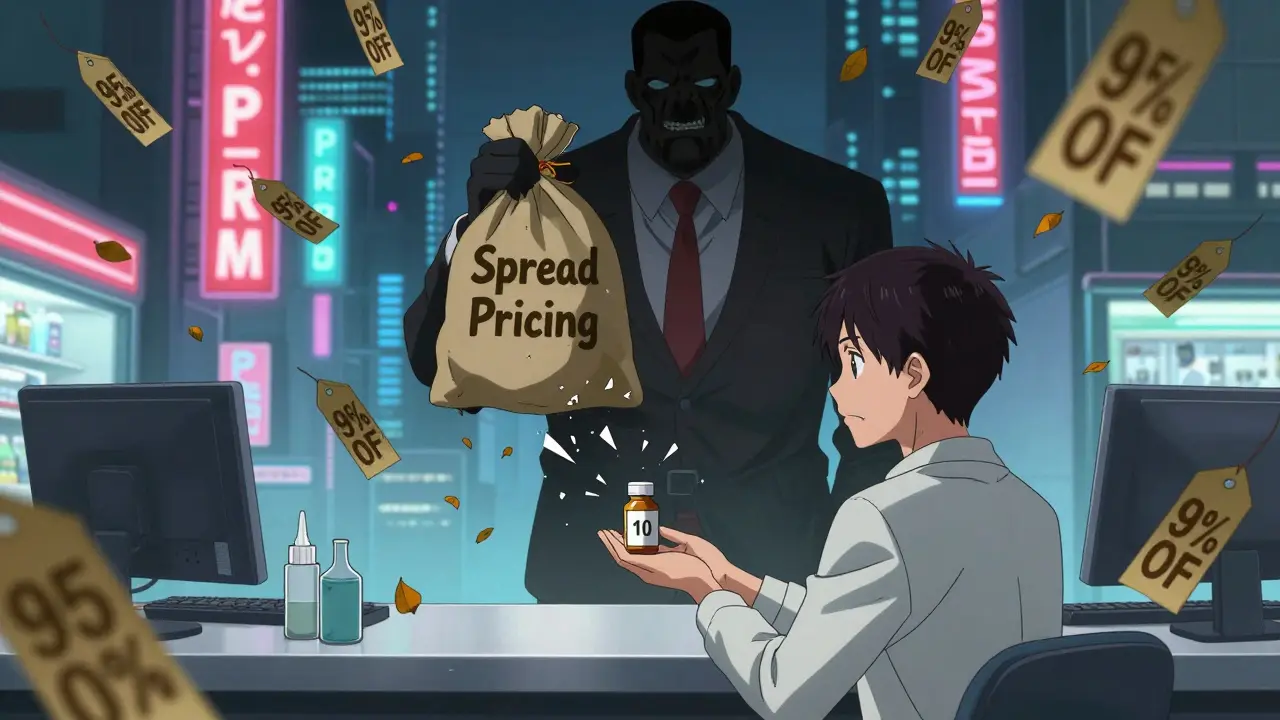
One sneaky trick? Spread pricing. That’s when a PBM tells your insurance you pay $15 for a drug, but they only pay the pharmacy $5. You think you’re saving money. But you’re actually paying $10 more than you need to. And your pharmacist isn’t allowed to tell you that cash price is lower.
Another problem: copay clawbacks. If your insurance copay is $10 but the cash price is $5, some PBMs still charge you $10. Then they pocket the extra $5. It’s legal. It’s common. And it’s why people with Medicare or private insurance sometimes pay more than someone paying out-of-pocket.
Real-world savings (and surprises)
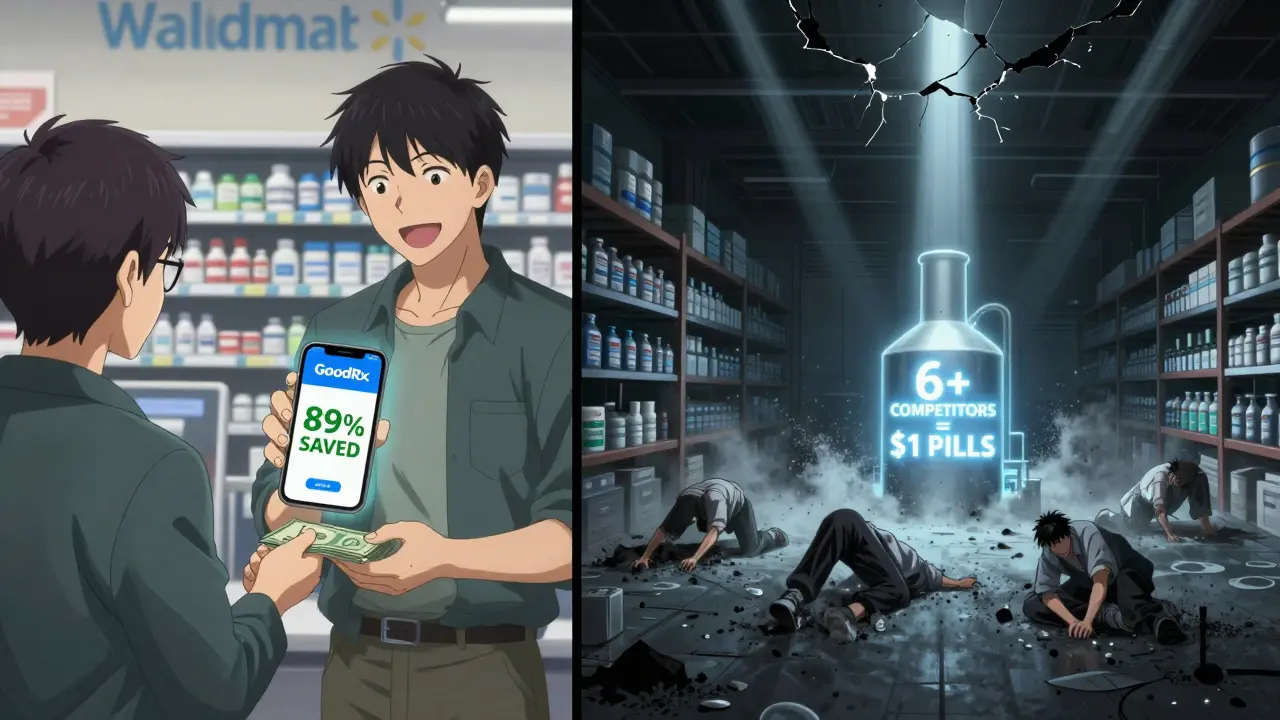
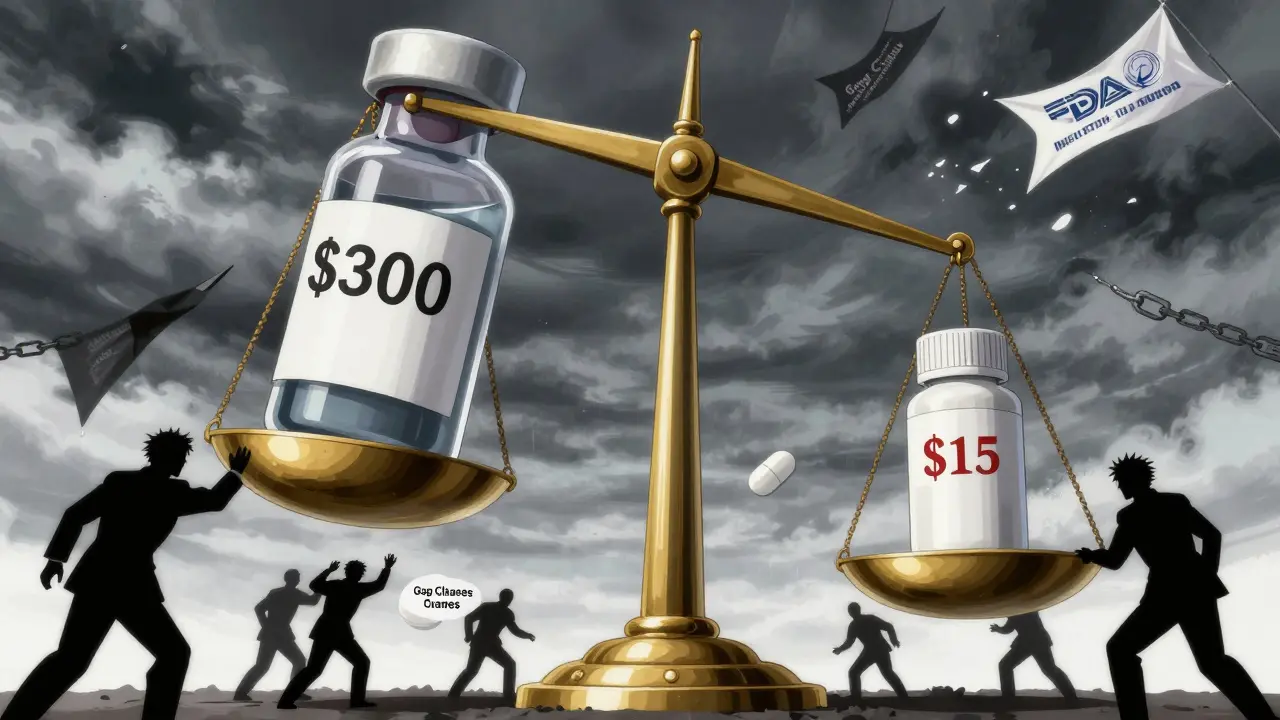
People on Reddit’s r/healthcare thread in 2023 shared stories that paint a mixed picture. One user paid $0 for metformin and lisinopril using Walmart’s $4 program. Another paid $300 for an EpiPen-even though a generic version existed for $15. What’s the difference? Awareness.
GoodRx data from early 2024 shows an average 89% savings on generics compared to brand names. But that’s an average. Some drugs? Savings are tiny. Insulin biosimilars, for example, still cost 85% of the brand price because only a few companies make them. No competition = no savings.
And here’s something most people don’t know: generic doesn’t always mean cheapest. If only one company makes a generic, it can cost almost as much as the brand. That’s why checking prices matters.
How to actually save money
You can’t control how many companies make a drug. But you can control how you buy it.
- Ask for the cash price. Always. Even if you have insurance. In 28% of cases, the cash price is lower than your copay. Pharmacists used to be blocked from telling you this by "gag clauses." Those were banned in 2018, but many still don’t offer the info unless asked.
- Compare prices. The same generic drug can cost $2 at one pharmacy and $60 at another. Use GoodRx, SingleCare, or even call three local pharmacies. Price differences of 300% are real.
- Use discount programs. Walmart, Costco, and Target offer $4 to $10 lists for dozens of common generics. No insurance needed.
- Focus on chronic meds. A $5 difference on a daily pill adds up to $1,825 a year. That’s why metformin, blood pressure pills, and statins are your best targets.
- Check therapeutic equivalence. Look for "AB" ratings on the drug label. That means it’s bioequivalent to the brand. No need to overpay for a "premium" generic.
The dark side: shortages and market collapse
There’s a flip side to price wars. When prices drop too far, manufacturers stop making the drug. Why? Because they can’t make a profit.
In 2024, a study found that 30% of generic drug shortages happened in markets with four or more competitors. That sounds backwards-until you realize that when five companies are fighting over a $1 pill, the one with the lowest overhead wins. The others shut down. Then, suddenly, there’s no supply. And prices spike.
That’s why drugs like apixaban (a blood thinner) have seen wild price swings. When competition drops, prices jump. And patients pay the price.
What’s changing?
The government is starting to act. The 2022 Inflation Reduction Act lets Medicare negotiate some drug prices. The 2023 Pharmacy Benefit Manager Transparency Act aims to ban spread pricing. The FDA approved over 1,000 generics in 2023-up from 748 the year before. More competition is coming.
But until PBMs are forced to pass savings directly to patients, the system will keep working against consumers. The math is clear: more competitors = lower prices. But only if you know how to use it.
Bottom line? Generic price wars are real. And they’re saving billions. But you have to be the one to claim your share.
Miksi yleisten lääkkeiden hinnat vaihtelevat niin paljon eri apteekissa?
Hinnat vaihtelevat, koska apteekit ja farmaseuttiset hyödyntäjät (PBMs) käyttävät erilaisia hintajärjestelyjä. Jotkut apteekit tarjoavat edullisia listoja (esim. $4), toiset perivät korkeamman hinnan, joka sisältää osan PBM:n voitosta. Käteinen hinta on usein paljon alempi kuin vakuutusmaksu, mutta se ei ole aina ilmoitettu.
Onko yleinen lääke aina yhtä tehokas kuin alkuperäinen?
Kyllä, jos se on merkitty "AB"-koodilla. Tämä tarkoittaa, että FDA on vahvistanut, että yleinen lääke on biologisesti yhtä tehokas kuin alkuperäinen. Ei ole erityistä "parempaa" yleistä versiota. Vain hinta vaihtelee.
Miksi jotkut yleiset lääkkeet ovat edelleen kalliita?
Jos vain yksi tai kaksi yritystä valmistaa lääkettä, kilpailu on vähäistä. Tällöin hinta pysyy korkeana, koska ei ole paineita alentaa sitä. Tämä tapahtuu esimerkiksi joissain harvoilla käytetyillä lääkkeillä tai kun valmistajat ovat muuttaneet markkinoilta.
Voinko saada yleisen lääkkeen ilmaiseksi vakuutuksellani?
Ei aina. Jotkut vakuutukset perivät maksun, vaikka kassahinta olisi nolla. Tämä johtuu PBM:ien käytännöistä, joissa vakuutusyhtiöiden ja apteekkien välillä oleva "kattaus" lisää hintaa. Käteinen maksu tai $4-ohjelmat (kuten Walmart) ovat usein parempi vaihtoehto.
Mitä teen, jos yleinen lääke loppuu ja en saa sitä?
Jos lääke loppuu, soita lääkärillesi. Hän voi ehdottaa vaihtoehtoa, joka on saatavilla, tai pyytää erityistä toimitusta. Myös FDA:n sivusto tarjoaa tietoa lääkepuutoksista. Tarkista myös, onko toinen valmistaja tuottanut saman lääkkeen-joskus hinnat vaihtelevat suuresti.
Anne Sofie Torstensson
maaliskuu 20, 2026 AT 16:11It's not just about competition-it's about power. The system was designed to make you think you're saving money, but really, you're just playing a rigged game where PBMs win every time. And don't get me started on how pharmacies are legally silenced. This isn't capitalism. It's corporate feudalism with a pharmacy counter.
Anders Holm
maaliskuu 21, 2026 AT 04:07Check GoodRx. Always. Cash price often 80% cheaper than insurance copay. Simple. No drama. Just facts.
Alexander Loodin Ek
maaliskuu 22, 2026 AT 16:05One must contemplate the metaphysical implications of pharmaceutical commodification. The very notion of a 'generic' drug-reduced to a mere economic abstraction-strips away the sacredness of healing. We have turned medicine into a commodity traded on the altar of neoliberalism. And yet… I still take my metformin. How tragic. 😔
Kristina vB
maaliskuu 23, 2026 AT 08:54Walmart’s $4 list saved me $600 last year. 🙌 Also, never trust your insurance to tell you the truth. Always ask for cash price. Easy money.
Helena War
maaliskuu 24, 2026 AT 17:46One must ask: Is the human body, in its biological essence, truly reducible to a series of chemical transactions? When we reduce life-saving medication to a price-per-pill metric, do we not, in essence, commodify suffering itself? The FDA may certify equivalence-but can it certify dignity? I fear not.
Jori Jackard
maaliskuu 26, 2026 AT 03:15Same thing in Finland. A friend paid €120 for insulin. Cash price? €18. At K-Citymarket. The system is broken. We need transparency. And yes, I checked three pharmacies. The difference was 700%. 😳
Maria Simson
maaliskuu 27, 2026 AT 23:37Tomi Räsänen
maaliskuu 29, 2026 AT 16:03You're all missing the point. The real issue isn't PBMs-it's that the FDA approves generics too fast. Half of them are just rebranded Chinese powder. I worked in a lab. I know. You think you're saving money? You're just gambling with your liver.
Drew Lundberg
maaliskuu 31, 2026 AT 14:01Oh wow. Another feel-good story about 'competition.' Let me guess-you also believe the moon landing was real and that IKEA furniture doesn't come with a side of existential dread? The 'price war' is a myth. It's a distraction. The real war is against your dignity. They let you pay $10 for metformin… so you'll stop asking why your insulin costs $300. Genius. 🤡
Robert Samuelsson
huhtikuu 2, 2026 AT 03:47While I appreciate the data presented, I must note that the very premise of 'generic equivalence' is a philosophical fallacy. The active ingredient may be identical, but the excipients, the manufacturing environment, the soul of the pill-it is not the same. I refuse to consume a pill produced under fluorescent lights in a facility with no windows. There is dignity in the brand. Even if it costs more.
Kaarina Meriläinen
huhtikuu 2, 2026 AT 21:29My sister pays €1.50 for her blood pressure pills at a Finnish pharmacy. No insurance. Just cash. Why do people overpay? Because they're lazy. Or scared. Or both.
Erik Cremonesi
huhtikuu 3, 2026 AT 17:24GoodRx is useless. I tried it. Prices were wrong. The app is outdated. Don't trust technology. Talk to your pharmacist. Actually talk to them. Not the guy behind the counter. The one with the white coat. He knows.
Erik Heimlich
huhtikuu 4, 2026 AT 02:44This is actually really helpful. Thank you for sharing. I never knew cash prices could be so much lower. I’ll start asking next time. 🙏